
- by Kody Ortner
ADHD, Anxiety, and a Messy Home: Why Your Environment Affects Your Mental Health More Than You Think
- by Kody Ortner
There is a particular kind of guilt that comes with a messy home when you're already overwhelmed. It's not just the mess itself. It's the awareness of the mess, the low hum of it sitting in the background of everything else you're trying to think about, the voice that says you should have dealt with this already and the exhaustion that comes from not knowing where to start.
If that sounds familiar, you are not alone. And more importantly, you are not lazy.
The relationship between your environment and your mental health is real, it is well researched, and understanding it might be the most useful thing you read this week.

Visual clutter is not a neutral experience for the brain. When your environment is disordered, your brain's visual cortex is processing a constant stream of competing stimuli, each one quietly demanding a small amount of attention. Researchers at Princeton University found that physical clutter in your field of vision competes for your cognitive resources and reduces your ability to focus, even when you're not consciously thinking about the clutter at all.
In plain terms, a messy room makes it harder to think clearly in that room, regardless of what you're trying to do.
For most people this creates a manageable background hum of low-grade stress. For people managing anxiety, ADHD, or burnout, the effect is significantly amplified. The cognitive load of a disordered space stacks directly on top of a nervous system that is already working overtime, and what might feel like mild discomfort to someone else can feel genuinely paralyzing to someone who is already stretched thin.
This is not a character flaw. It is neuroscience.
Here is the part that most productivity advice completely misses. For people managing anxiety or ADHD, the barrier to cleaning is rarely about time or motivation in the conventional sense. It's about initiation.
The brain's executive function system is responsible for starting tasks, switching between them, and carrying them through to completion. In anxiety, the executive function is often hijacked by threat-monitoring and worst-case thinking. In ADHD, the dopamine pathways that make task initiation feel rewarding are structurally different, making it genuinely harder to begin something without a clear and immediate sense of reward.
This is why standing in the middle of a messy room and telling yourself to just clean it rarely works. The instruction doesn't come with the neurological fuel to execute it. And the longer you stand there not starting, the more the anxiety or shame compounds, which makes starting even harder.
Understanding this doesn't mean accepting the mess. It means approaching the solution differently.
The most effective strategy for people who struggle with task initiation is not to attempt the whole thing. It's to make the first action so small that it barely counts as a task at all.
Pick one surface. Not the whole kitchen, not the whole room. One surface. The counter next to the sink. The coffee table. Your nightstand. Give yourself permission for that to be the entire goal.
Here is what happens when you do this consistently. Each small action delivers a modest but real dopamine reward to the brain. The task is completed, the brain registers success, and the barrier to the next small action is slightly lower than it was before. This is how momentum builds in a brain that struggles with initiation. Not through willpower, but through small sequential wins that train the reward system to associate cleaning with completion rather than overwhelm.
Over time, those small wins compound into a genuinely clean and ordered space, and more importantly, into a different relationship with the process of maintaining it.

One of the most under-appreciated tools for people who struggle with starting is sensory priming, and scent is the most powerful sensory priming tool available to us.
Because olfactory signals travel directly to the limbic system, the emotional and motivational center of the brain, scent can shift your internal state before your conscious mind has had a chance to talk you out of starting. This is particularly valuable for people with anxiety or ADHD, where the mental chatter around a task often does more damage than the task itself.
Using a consistent scent every time you clean builds a conditioned association between that scent and the act of beginning. Over time, the scent alone begins to function as a trigger for the cleaning state of mind, lowering the activation energy required to start.
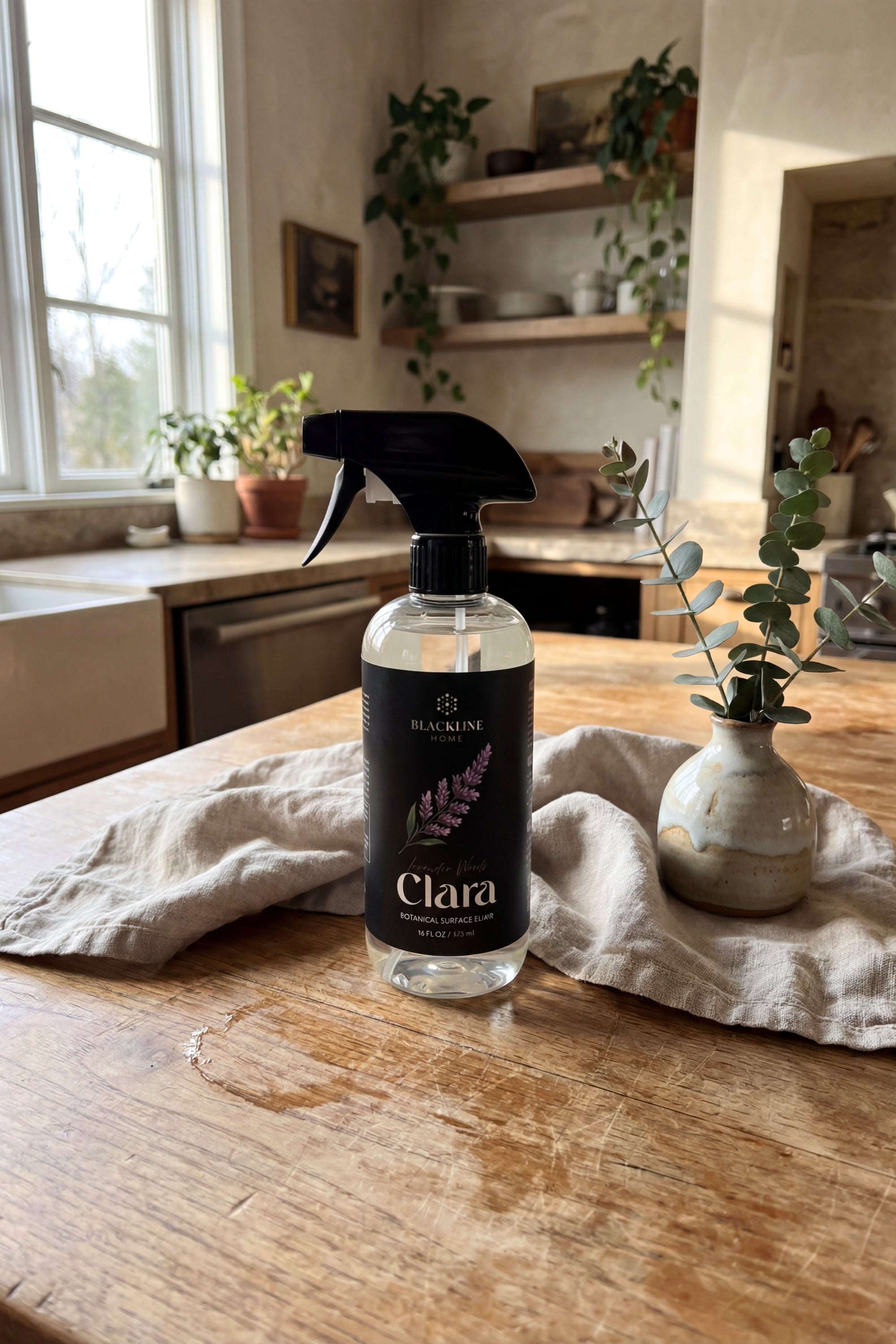
Spray Clara on a single surface. Let the scent land. Take one action. That's all it takes to begin, and beginning is the hardest part.
Eucalyptus Mist is particularly well suited here. Its clarifying, spa-like quality has been linked to improved alertness and cognitive performance, making it an ideal companion for the moment of initiation when the brain most needs a signal that something intentional is about to happen.
One of the most consistent findings in ADHD and anxiety research is that external structure compensates for what internal structure struggles to provide. When the environment is ordered, the brain has less work to do. When routines are consistent, initiation becomes easier because the brain is not reinventing the decision every time.
The Sunday Reset, done consistently, becomes that external structure. It creates a predictable weekly anchor that your brain can rely on rather than resist. The same day, the same order, the same scents, the same small sequence of actions. Not because rigidity is the goal, but because predictability reduces the cognitive friction that makes starting hard.
You are not creating a chore. You are creating a scaffold for your week that happens to result in a clean home as a side effect.
The space you live in is not a backdrop to your life. It is an active participant in how you feel, how clearly you think, and how capable you feel of handling what the week brings.
A disordered space doesn't cause anxiety or ADHD. But it does feed them. And an ordered space, created through small intentional actions and a ritual you can actually sustain, can do more for your baseline mental state than most people give it credit for.
You don't have to overhaul everything at once. You just have to start somewhere small, with intention, and let the momentum do the rest.
Start with one surface. Start with Clara. Your daily anchor ritual, designed for the moments when starting is the hardest part.
One surface. One step. One reset at a time.